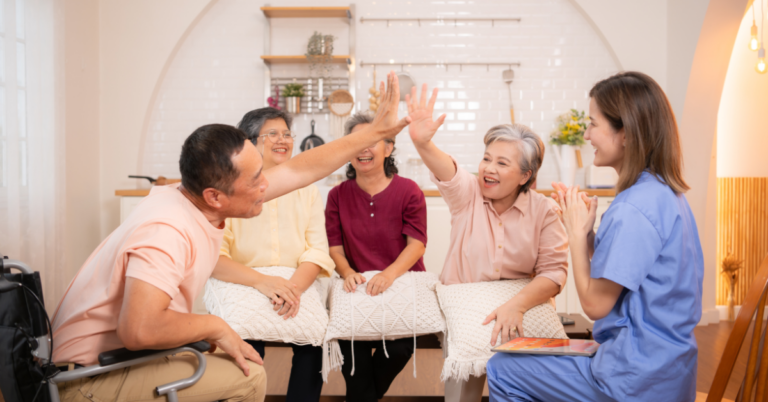


Your mother’s eyes may not recognize your face anymore, but watch what happens when you bring her favorite perfume into the room. For families with loved ones in a memory care community in Menomonee Falls, Valentine’s Day can feel like an impossible celebration.
How do you share love with someone whose words have disappeared? The answer lies in a language that dementia cannot steal—the language of scent and touch. These sensory experiences slip past the cognitive barriers that Alzheimer’s builds, finding their way directly to the heart of memory itself.
Sensory integration strengthens both confidence and cognitive ability, benefiting people of all ages. For your loved one living with dementia, this means Valentine’s activities can still spark genuine joy. Picture the moment when the scent of roses awakens a smile or when a gentle hand massage communicates the love that words can no longer carry.
Why Does The Scent Of A Rose Trigger Memories When A Photo Cannot?
Picture this: a daughter shows her father with dementia a wedding photo from decades ago. He stares blankly, no recognition crossing his face. Then she opens a small vial of her mother’s perfume—the same fragrance he bought for their first anniversary. Suddenly, his eyes light up and he whispers her name.
This scene plays out in memory care communities across the country and the science behind it reveals something remarkable about how our brains work.
The olfactory-limbic connection explained
Unlike every other sense we possess, smell takes a direct route to our emotional centers. While a photograph must travel through the brain’s relay station (the thalamus) before reaching memory areas, scent molecules bypass this checkpoint entirely. They travel straight from the nose to the limbic system—specifically the amygdala, where we process emotions and the hippocampus, where memories live.
How scent bypasses cognitive decline
Here’s what gives families hope: while dementia attacks conscious memory, it often leaves implicit memory systems remarkably untouched. Scent-triggered memories happen automatically, without the effort that conscious recall demands. This explains why aromatherapy works particularly well for seniors who struggle with aphasia or have difficulty finding words.
Benefits of aromatherapy in memory care communities
Memory care communities have documented specific advantages when incorporating aromatherapy:
- Reduced agitation: Lemon balm essential oil applied to faces and arms calmed agitation symptoms.
- Improved sleep quality: Lavender and other relaxing scents help establish bedtime routines and encourage deeper rest
- Enhanced mood: Essential oils directly influence emotional centers, potentially easing depression and anxiety symptoms
- Mental engagement: Identifying and discussing different scents provides gentle cognitive stimulation without pressure
For Valentine’s Day celebrations, the fragrance of roses or the aroma of baking cookies can spark conversation, bring smiles and build meaningful connections—even when words are hard to find.

How Does Gentle Touch Calm The Nervous System In Dementia Care?
Touch speaks when words cannot. For seniors living with dementia, human connection through gentle physical contact opens pathways that verbal communication often cannot reach.
The science behind touch therapy
Touch therapy triggers the release of oxytocin, serotonin and dopamine—brain chemicals that naturally improve mood, reduce stress and support memory recall (Field et al, 2005). When you hold your father’s hand or gently massage your mother’s shoulders, you’re activating a biological response that goes far deeper than simple comfort. You are increasing serotonin levels, creating genuine feelings of calm and reducing anxiety.
Tactile therapy vs. verbal communication for seniors with aphasia
Touch functions as a universal language that requires no translation. For seniors struggling with language processing or expression, physical contact communicates care and safety in ways that words simply cannot.
Consider this difference: verbal communication demands cognitive processing that dementia often impairs. Touch, however, communicates care and reassurance directly. Your gentle presence and physical contact usually reach your loved one more effectively than the most carefully chosen words.
How Does A Memory Care Community In Menomonee Falls Bring It All Together?
The theories behind sensory care mean little without skilled hands to put them into practice. Heritage Court Menomonee Falls has built something special—a community where the science of scent and touch becomes daily compassion.
Local traditions and familiar scents
Wisconsin winters carry their own comfort scents and Heritage Court understands this deeply. We participate in the Wild Plum Memory Project, connecting our residents to broader community memory initiatives. These memory cafés welcome seniors with early-stage dementia, weaving familiar local aromas and traditions into meaningful social gatherings.
Community events that spark joy
Valentine’s Day at Heritage Court feels different from institutional celebrations elsewhere. Residents create personalized cards by hand, craft heart-shaped wreaths that fill rooms with natural fragrance and fill sachets with dried lavender that perfumes their living spaces for weeks. These projects activate multiple brain regions while strengthening motor skills.
How Heritage Court Menomonee Falls uses sensory programming
At Heritage Court, we provide individualized dementia support around the clock, but our real strength lies in connecting residents to what still brings them joy. Our specialized programs blend cognitive activities with music therapy, using technology thoughtfully to maintain connections to personal interests.
Art therapy opens doors when words close them. Residents who struggle with conversation can still express themselves through painting and crafting, finding communication pathways that dementia hasn’t touched.
Love, Scents and Retirement
Love finds a way, even when memory fades. Throughout this exploration of sensory connection, one truth emerges clearly:
Dementia cannot silence the heart’s ability to recognize care and comfort. Your loved one’s face may light up at the scent of roses, even as their own reflection seems foreign, because sensory memory challenges work differently than we often expect.
The science backs up what families witness daily. Hand massages release those healing neurotransmitters that create calm from chaos. Familiar scents bypass the broken pathways and reach emotional centers that remain surprisingly intact. These aren’t just lovely ideas—they’re measurable interventions that change cortisol levels and reduce agitation within minutes.
Heritage Court Menomonee Falls has made this philosophy its daily practice. Our residents benefit from programming that honors individual histories while addressing the real challenges of sundowning and social isolation. Call Heritage Court Menomonee Falls at (262) 781-6930 to schedule a tour and see how sensory-focused care can bring more moments of recognition and joy to your family’s journey.
FAQs
Q1. How can scent therapy benefit seniors with memory loss?
Scent therapy can awaken emotional memories and calm the brain, helping improve mood, reduce agitation and support better sleep.
Q2. What are good Valentine’s Day activities for people with dementia?
Simple sensory activities like aromatherapy, baking, soft crafts, music and gentle touch help create a sense of comfort and emotional connection.
Q3. How does touch therapy help seniors with dementia?
A gentle touch, like a hand massage, relaxes the nervous system, lowers stress and reduces agitation while communicating care without words.